I. Why Boat Trailer Weight Matters More Than You Think
Most boat owners only think about trailer weight after they buy one often when they’re standing in the driveway wondering:
Can my SUV even tow this?
Will this strain my axle?
Why does my vehicle feel unstable at highway speeds?
Trailer weight isn’t just a number. It determines how safely you tow, how much fuel you burn, and whether your vehicle is legally capable of pulling your boat.
So the big question is…
How much does a boat trailer actually weigh?
This guide breaks everything down real trailer weight ranges, the factors that impact weight, how to measure yours accurately, and how to pick a trailer that matches your tow vehicle.
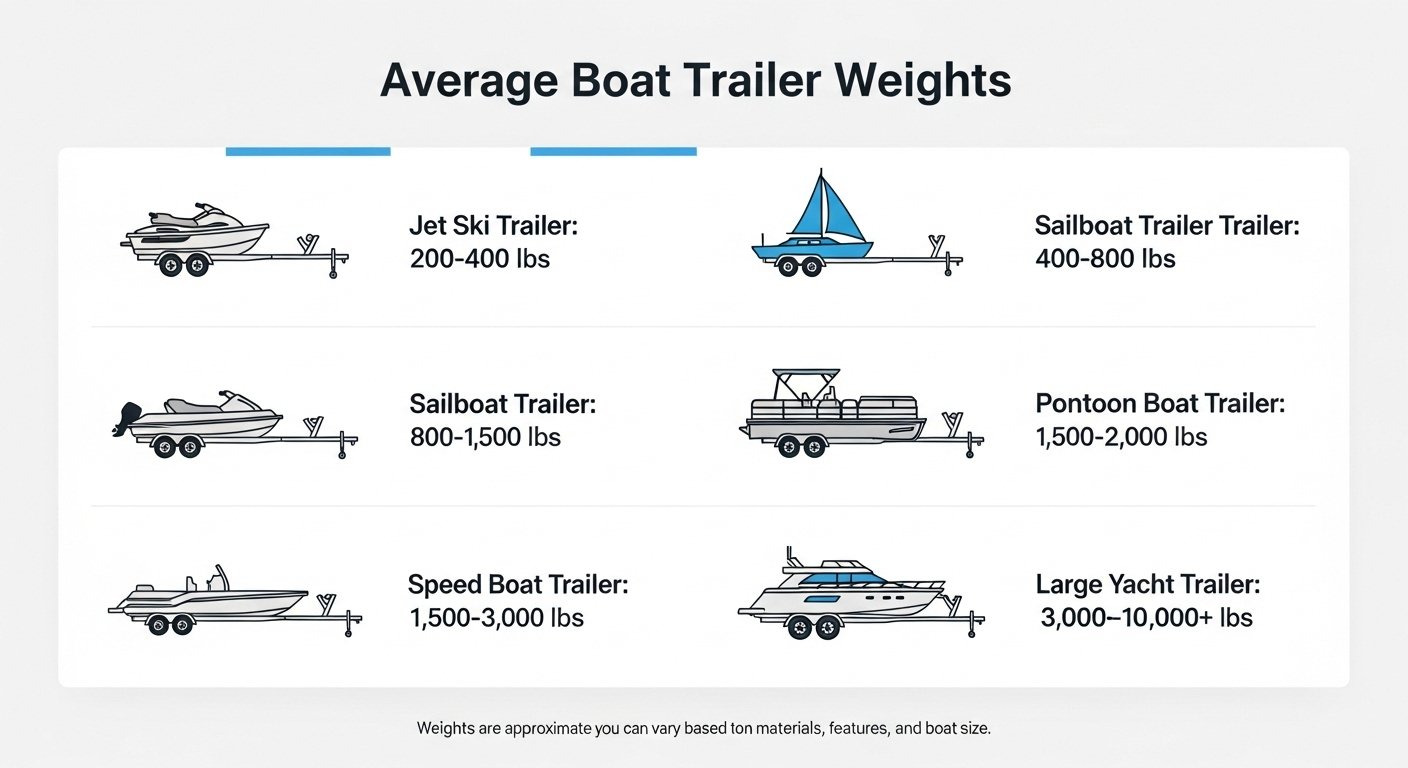
II. Average Boat Trailer Weights by Type
| Trailer Type | Average Weight |
|---|---|
| Small boat trailers (12–16 ft) | 200–400 lbs |
| Mid-size boat trailers (17–21 ft) | 400–800 lbs |
| Large boat trailers (22–25+ ft) | 800–1,500+ lbs |
| Pontoon boat trailers | 800–1,600 lbs |
| Tandem-axle trailers | 1,000–2,000+ lbs |
II. What Actually Determines a Boat Trailer’s Weight?
Two trailers designed for the same boat size can still differ by hundreds of pounds. Here’s why:
1. Trailer Material
Steel trailers
Heavier, stronger, lower cost but they add more weight for your tow vehicle.Aluminum trailers
Up to 20–30% lighter, corrosion-resistant, and often preferred for saltwater use.
2. Trailer Type
The design drastically changes the weight:
Bunk trailers – lightest and most common
Roller trailers – heavier due to moving parts
Pontoon trailers – wider, reinforced frames
Custom trailers – often heavier
Tandem-axle trailers – double axles = more weight
3. Boat Size Compatibility
Trailers built for larger boats require:
Thicker beams
Stiffer suspension
Heavier-duty frames
Reinforced materials
Bigger boat = bigger trailer.
4. Axles & Suspension
A huge weight factor:
Single-axle trailers → light, easy to maneuver
Tandem-axle trailers → significantly heavier
Dual axles improve stability, but add 200–600 lbs depending on design.
5. Added Components
These can quietly add 100+ pounds:
Spare tire mounts
Winches
Trailer brakes
Guides
Steps
Storage trays
Even the accessories influence final weight.
IV. Boat Trailer Weight vs. Boat Weight: Don’t Mix Them Up
Many boaters make a critical mistake: assuming the boat weight includes the trailer weight.
It doesn’t.
Here are the three terms you need to know:
1. Trailer Weight
The weight of the trailer alone (empty).
2. Boat Weight
The dry weight of the boat (without fuel or gear).
3. Gross Trailer Weight (GTW)
This is the most important number:
GTW = Trailer + Boat + Fuel + Gear + Batteries + Coolers + Everything
Why it matters:
Towing capacity
Your vehicle has a maximum it can tow GTW must stay under that limit.Safety
Overloaded trailers sway, lose braking power, and damage brake systems.Fuel efficiency
A heavier load burns more fuel every mile.Stopping distance
Weight dramatically impacts braking especially on downhill grades.
Example GTW Calculation
Let’s say you have:
Boat: 2,000 lbs
Fuel: 150 lbs
Gear: 120 lbs
Trailer: 700 lbs
GTW = 2,970 lbs
This is the number your tow vehicle must handle—not just the trailer.
V. How to Find the Exact Weight of Your Trailer
Estimating is risky. Here are three reliable ways to get accurate numbers:
1. Manufacturer Plate / VIN Sticker
Most trailers include a small plate with:
GVWR (Gross Vehicle Weight Rating)
GAWR (Axle Weight Rating)
Trailer weight or capacity
You’ll usually find it:
Near the tongue
On the frame
Near the axles
2. Owner’s Manual or Manufacturer Website
If your trailer model is standard and hasn’t been modified, the manufacturer’s specs are usually accurate.
3. Use a Vehicle Scale (Most Accurate)
Perfect for older, custom, or modified trailers.
How to weigh an empty trailer:
Go to a public weigh station or CAT scale.
Disconnect the trailer from the vehicle.
Roll only the trailer onto the scale.
Record weight.
How to weigh a loaded trailer:
Weigh your vehicle alone.
Weigh the vehicle + trailer.
Subtract the two numbers.
Common Mistake to Avoid
Relying on brochure weight.
Those numbers often exclude:
Brakes
Spare tires
Added hardware
Winches
Guides
Always verify.
VI. Different Trailer Types & Their Typical Weights
A deeper breakdown to help identify where your trailer fits:
1. Bunk Trailers
Weight: 200–1,000 lbs
Why lighter: Simple design with minimal moving parts
Best for: Most standard fishing boats and bowriders
2. Roller Trailers
Weight: 400–1,500 lbs
Why heavier: Dozens of rollers, brackets, mounts
Best for: Easy launching in shallow ramps
3. Pontoon Trailers
Weight: 800–1,600 lbs
Why heavier: Wider footprint, dual rails
Best for: Pontoons of all sizes
4. Jon Boat / Small Utility Trailers
Weight: 150–300 lbs
Best for: Small aluminum boats (10–14 ft)
5. Tandem-Axle Boat Trailers
Weight: 1,000–2,000+ lbs
Best for: Large boats, offshore boats, speedboats
VII. How Much Weight Can Your Tow Vehicle Handle?
Understanding your tow vehicle specs is just as important.
1. Towing Capacity
The maximum your vehicle can tow safely.
Find it in your owner’s manual.
2. Tongue Weight
The downward force the trailer puts on your hitch.
General rule:
Tongue weight = 10–15% of total trailer weight
3. Gross Combined Weight Rating (GCWR)
Maximum allowable weight of:
Vehicle
Passengers
Cargo
Boat
Trailer
Why Exceeding Limits Is Dangerous
Overheating
Brake failure
Transmission damage
Reduced steering control
Sway at highway speeds
Red Flags Your Vehicle Is Overloaded
Significant rear sag
Steering feels light
Poor acceleration
Excessive sway
Longer stopping distance
VIII. Why Trailer Weight Impacts Towing Safety
The heavier the trailer, the more it affects:
1. Braking Distance
Heavy trailers require much more stopping power.
2. Stability
Light vehicles pulling heavy trailers are especially vulnerable to sway.
3. Fuel Efficiency
Weight + wind drag = higher fuel burn.
4. Tire Wear
Underinflated or overloaded tires can fail quickly.
5. Sway Risk
Happens when:
Trailer is heavier than the tow vehicle
Weight distribution is poor
Tires aren’t inflated properly
Trailer Brake Requirements
Many states require brakes when trailers exceed:
1,500–3,000 lbs depending on location
Always check your local law.
IX. If Your Trailer Is Too Heavy: What Should You Do?
You have several options:
1. Upgrade Your Tow Vehicle
If towing is a long-term activity, this is the safest solution.
2. Reduce Boat Load
Remove:
Excess gear
Water
Batteries
Fuel
Every pound counts.
3. Add Trailer Brakes
Electric or surge brakes increase stopping power.
4. Switch to an Aluminum Trailer
You may cut 100–300 lbs instantly.
5. Replace Rusted or Damaged Components
Old steel parts can add unnecessary weight.
6. Replace the Trailer Entirely
If it’s too light, too heavy, or unsafe don’t risk it.
X. FAQs
1. How much does a single-axle boat trailer weigh?
300–1,000 lbs, depending on size and material.
2. Are aluminum boat trailers lighter than steel?
Yes typically 20–30% lighter.
3. How much weight do boat trailer brakes add?
Usually 25–75 lbs depending on the system.
4. Can I tow a boat trailer without knowing the weight?
You can, but it’s risky and often unsafe. Always verify weight first.
5. What’s the safest weight for highway towing?
Stay 20% under your vehicle’s maximum tow rating for best control.
XI. Conclusion — Know Your Trailer Weight, Tow Smarter
Trailer weight is one of the most overlooked but most important—parts of safe boating. Once you know:
Your trailer weight
Your boat’s weight
Your gross trailer weight
Your tow vehicle limits
…towing becomes safer, smoother, and far more predictable.
A quick recap:
Small boat trailers: 200–400 lbs
Mid-size: 400–800 lbs
Large: 800–1,500+ lbs
Pontoon: 800–1,600 lbs
Tandem-axle: 1,000–2,000+ lbs
Curious how wide a boat trailer should be? Click here to get the full guide!