If you own an RV, planning for storage is one of the most important considerations. Improper storage can lead to fines, permit violations, and neighborhood disputes. The key to legally storing your RV is understanding what zoning is needed for RV storage. This guide dives deep into zoning classifications, permit requirements, and real-life strategies to ensure your RV storage is both compliant and convenient.
Short Answer: Quick Guide on RV Storage Zoning
Immediate Answer for Homeowners and Business Owners
In most regions, RV storage falls under residential, commercial, industrial, or agricultural zoning. The rules vary depending on whether the storage is private (homeowners) or public (business).
- Residential zoning: Often allows one or two RVs on private property with restrictions, sometimes requiring special permits.
- Commercial zoning: Permits medium-to-large storage facilities designed for multiple vehicles.
- Industrial zoning: Suitable for large-scale storage yards, often requiring full compliance with commercial codes.
- Agricultural zoning: Flexible, particularly in rural areas, but still subject to local safety and access requirements.
Real-life example: In Texas, many homeowners with R1/R2 residential zoning successfully store a personal RV on their property after obtaining a special conditional use permit.
Understanding Zoning for RV Storage
What Zoning Means in Practical Terms
Zoning is a regulatory tool local governments use to designate how land can be used. It determines whether your property is suitable for residential, commercial, industrial, or agricultural purposes. Zoning impacts where you can legally store an RV, the number of RVs allowed, and the type of permits you may need.
Residential vs Commercial vs Industrial Zoning
- Residential: Typically allows for one or two personal RVs. Restrictions often include size limits, setbacks from the street, and visible storage prohibitions.
- Commercial: Designed for storage businesses, accommodating 10–50 RVs depending on lot size and local regulations.
- Industrial: Used for large-scale operations or storage yards, often with strict compliance rules for safety and access.
Key Factors That Influence RV Storage Zoning
Lot Size and Property Type
Minimum lot size is a common restriction.
- Residential: Usually requires 1 acre or more for RV storage.
- Commercial: Often requires 5 acres or more, depending on capacity and local codes.
Safety and Accessibility Regulations
RV storage must consider:
- Fire safety compliance
- Emergency vehicle access
- Adequate road and driveway space
HOA Rules and Local Ordinances
Even if zoning allows RV storage, homeowners’ associations (HOAs) can impose visibility restrictions or require additional screening. Many HOAs require Privacy RV solutions, such as fencing or landscaping, to block the vehicle from view. Suburban neighborhoods often prohibit storage in front yards, while rural areas tend to be more flexible.
Guide to Determining Zoning for RV Storage
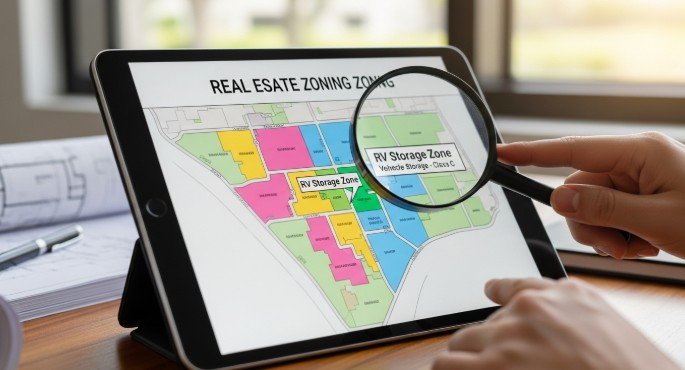
Check Your Local Zoning Maps
Start by reviewing municipal zoning maps online. Identify your property’s current zoning and note any overlays or special districts.
Identify Your Property’s Zoning Classification
Confirm whether your property is classified as residential, commercial, industrial, or agricultural, as this determines the type of RV storage legally permitted.
Review Local Land-Use Codes
Dive into your city or county land-use codes. Look for sections related to vehicle storage, accessory structures, and conditional use.
Determine Permit Requirements
Determine whether your project requires:
- Conditional use permits
- Variances
- Exemptions
Permits may vary based on the number of RVs, lot size, and location relative to streets and neighbors.
Apply and Secure Approval
Submit your application to the planning department.
Real-life example: One small business owner secured a conditional use permit in 30 days and launched a profitable RV storage facility, maximizing compliance while serving multiple clients.
RV Storage Zoning Options
| Zoning Type | Suitable for RV Storage? | Maximum Capacity | Permit Required | Example Locations |
|---|---|---|---|---|
| Residential | Limited | 1–2 RVs | Sometimes | Suburban homes |
| Commercial | Medium to Large | 10–50 RVs | Yes | Business parks |
| Industrial | Large-scale | 50+ RVs | Yes | Industrial zones |
| Agricultural | Flexible | Varies | Sometimes | Rural land |
People Also Ask
Can I store an RV in my driveway?
Depending on zoning and HOA restrictions, storing one RV on a residential driveway may be allowed with certain permits.
Do I need a permit to store an RV on my property?
Yes, most cities require a permit if the RV is visible from the street or exceeds standard residential allowances.
How far from the street can RVs be stored?
Setback requirements vary but often require 10–20 feet from the street, depending on local ordinances.
Can HOA rules override city zoning for RV storage?
HOAs can enforce stricter rules than municipal zoning, so compliance with both is necessary.
Is indoor RV storage treated differently than outdoor?
Indoor storage often has more relaxed zoning restrictions but may still require building permits if modifications are made.
Are there special zoning laws for commercial RV storage businesses?
Yes, commercial storage typically requires industrial or commercial zoning and full adherence to safety, access, and environmental regulations.
Frequently Asked Questions (FAQs)
Q1: What is the typical process to get zoning approval for RV storage?
A1: Review zoning maps, check local land-use codes, apply for permits or variances, and secure approval from your planning department.
Q2: Can I store multiple RVs on residential property legally?
A2: Usually limited to 1–2 RVs unless a conditional use permit is approved.
Q3: How much does an RV storage permit cost?
A3: Costs vary by city and type of permit, ranging from $50–$500 for residential and higher for commercial facilities.
Q4: Are there safety or environmental regulations I need to follow?
A4: Yes. Fire safety, drainage, access, and sometimes environmental protection laws apply.
Q5: How does zoning affect RV storage pricing and insurance?
A5: Zoning can influence rental fees, insurance premiums, and liability coverage for commercial storage operations.
Q6: Can I convert a barn or garage for RV storage?
A6: Often yes, but local building codes and permit requirements must be followed.
Q7: What happens if I violate zoning rules for RV storage?
A7: Violations can result in fines, forced removal of the RV, and legal action.
Q8: How do I find the zoning requirements in my city?
A8: Contact your city’s planning department, consult online zoning maps, or hire a zoning consultant.
Conclusion: Navigating Zoning for RV Storage Successfully
Understanding what zoning is needed for RV storage is crucial to avoid legal issues, fines, and neighborhood conflicts. Residential, commercial, industrial, and agricultural zoning each have unique rules that affect how many RVs can be stored, where they can be parked, and what permits are required.
Insights I Have Gathered: Many property owners successfully combine conditional use permits, HOA compliance, and safety measures to maximize legal RV storage without complications.
Take action: Always consult your local planning department before making any storage investment. Following these steps ensures compliance, safety, and peace of mind while protecting your RV investment.