So you want to camp away from hookups and still keep your lights on, your fridge running, and your phone charged. Solar makes that happen, but the setup trips a lot of people up before they ever park somewhere quiet. Let me walk you through how to size rv solar panels for the way you actually camp, not the way a spec sheet says you should.
Start With What You Use, Not What You Buy
The mistake most people make is shopping for panels first. Flip that around. Before you spend a dollar, write down everything you plan to power and roughly how long it runs each day.
Make a quick load list
Grab a notebook and list your gear. Lights, water pump, phone chargers, laptop, fans, the fridge, maybe a TV. Next to each one, note the watts it pulls and the hours you run it. Your fridge might sip 60 watts but run most of the day. A laptop charger pulls 60 watts for an hour or two. Add it all up and you get watt hours, which is the number that drives everything else.
Most weekend campers land somewhere between 1,000 and 3,000 watt hours per day. Run an air conditioner and that figure climbs fast, which is its own conversation.
The Math Behind the Numbers
Watt hours tell you how much energy you burn. Now you need to know how much your panels can put back.
A 100 watt panel in good sun makes about 100 watts each hour. Over a day you might get four to six hours of strong sun, so call it 400 to 600 watt hours from that one panel. Clouds, shade, and panel angle pull that down, so plan for the low end.
Say you burn 1,500 watt hours a day. Divide that by 500 watt hours per panel and you need about three 100 watt panels to break even on a sunny day. Add a fourth if you camp under trees or chase fall and winter sun, when daylight runs short.
How Big Your Battery Bank Should Be
Panels only work while the sun is up. Your battery carries you through the night and through cloudy stretches, so it matters as much as the panels do.
A common rule is to store at least one full day of use, and two days if you like a cushion. If you burn 1,500 watt hours daily, a battery bank holding 1,500 to 3,000 watt hours keeps you covered. Lithium batteries let you use nearly all of that capacity. Lead acid batteries want to stay above half charge, so you buy double the rated size to get the same usable power.
Wiring, Charge Controllers, & the Stuff in Between
Panels do not plug straight into a battery. A charge controller sits in the middle and keeps the voltage in line so nothing cooks.
Pick the right controller
There are two kinds. PWM controllers cost less and suit small setups. MPPT controllers pull more out of your panels, sometimes 20 to 30 percent more, and earn their price once you run a few hundred watts. If you are building anything past one or two panels, go MPPT.
You also want an inverter if you run anything on regular wall current, like a laptop or a coffee maker. Size it to your biggest single load with room to spare.
Where the Panels Go
You have two paths here, and plenty of folks use both.
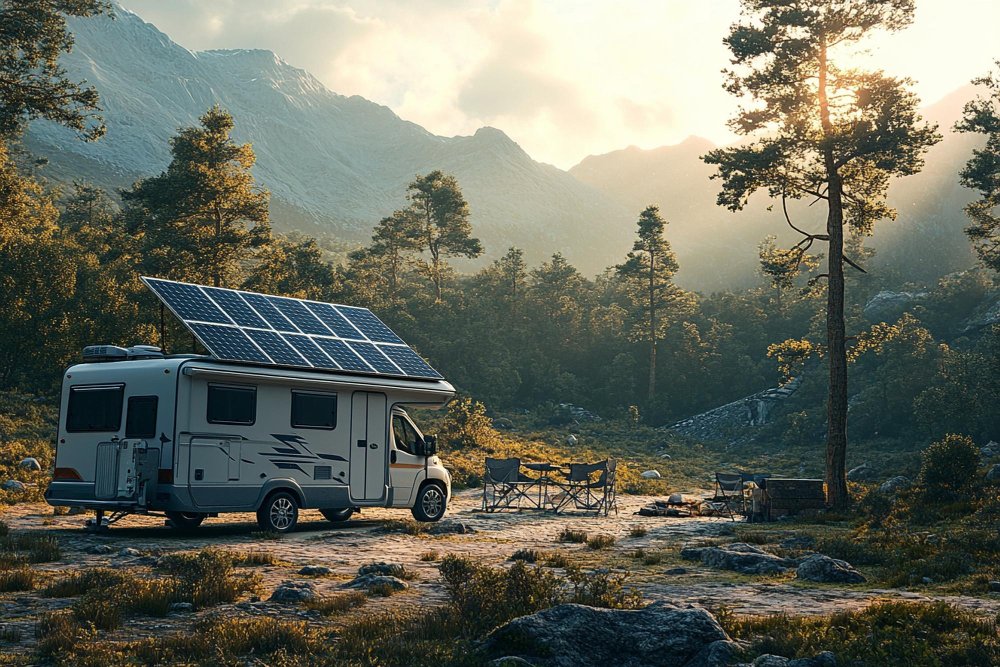
Roof mounted panels stay out of the way and charge while you drive or sit at camp. The catch is shade. Park under a tree and a roof panel does little.
Portable panels fold up, sit on the ground, and chase the sun. You move them through the day and tuck them away at night. Many campers run a fixed roof array for the easy days and keep a portable panel to fill the gap when they park in shade.
Mistakes That Cost You Power
A few traps catch first timers, so watch for these.
People skip the battery and wonder why the lights die at dusk. Panels alone do nothing after sunset.
People mount panels flat and lose output, since a flat panel misses the low sun of morning, evening, and winter. A slight tilt toward the sun helps.
People undersize the wire. Thin wire over a long run wastes power as heat. Use the gauge your panel maker calls for, or go thicker.
A Starter Setup That Works
If you want a place to begin without the spreadsheet, here is a setup that handles most weekend trips.
Run two or three 100 watt panels, an MPPT charge controller, and a 100 amp hour lithium battery, which holds roughly 1,200 watt hours. Add a small inverter for the laptop and chargers. That covers lights, the water pump, the fridge, and your devices for a long weekend with sun.
Scale up from there as you learn your habits. Track what you use for a few trips, watch how low the battery drops by morning, and add a panel or more battery where you come up short.
Off grid power is really just a balance. Put back what you take out, store enough for the dark hours, and your rv solar panels keep you parked wherever you like for as long as you like.