Installing solar panels on your RV roof is one of the most effective ways to achieve energy independence while traveling. Whether you’re a weekend camper or a full-time traveler, learning how to mount solar panels on RV roof correctly ensures reliable power, reduced generator use, and long-term savings.
With proper planning, tools, and safety precautions, you can build a solar setup that performs efficiently in all conditions from desert camping to coastal trips and even humid regions like Steinhatchee, Florida where RV travel is especially popular. For professional guidance and reliable RV solar solutions, Privacy RV can help ensure your system is designed and installed for long-term performance and safety.
Short Answer — How to Mount Solar Panels on RV Roof?
Mounting solar panels on an RV roof involves securing panels with brackets or adhesive mounts, wiring them to a charge controller, and connecting them to your RV battery system. The process also includes sealing all roof penetrations to prevent leaks and ensuring panels are positioned for maximum sunlight exposure.
Why Learn How to Mount Solar Panels on RV Roof?
Understanding the process helps you avoid costly mistakes and maximize your RV’s energy efficiency.
Benefits of RV Solar Power Systems
- Off-grid electricity independence
- Reduced generator fuel consumption
- Quiet, eco-friendly power generation
- Reliable energy during long camping trips
Common RV Solar Use Cases
- Full-time RV living
- Boondocking in remote areas
- Cross-country road trips
- Emergency backup power supply
Types of RV Solar Panel Mounting Systems
Fixed Mount Solar Panels
- Permanently installed on RV roof
- Best for long-term RV travelers
- Highly durable for highway vibration
Adjustable Tilt Mounts
- Panels can be angled toward the sun
- Improves energy efficiency
- Ideal for stationary camping setups
Portable Solar Panel Systems
- Not permanently installed
- Can be moved for optimal sunlight
- Great for temporary or flexible use
How to Mount Solar Panels on RV Roof?
Step 1 — Plan Your Solar Panel Layout
- Measure available roof space
- Avoid vents, AC units, and antennas
- Position for maximum sun exposure
Step 2 — Clean and Prepare RV Roof Surface
- Remove dirt, grease, and debris
- Ensure surface is completely dry
- Mark mounting points accurately
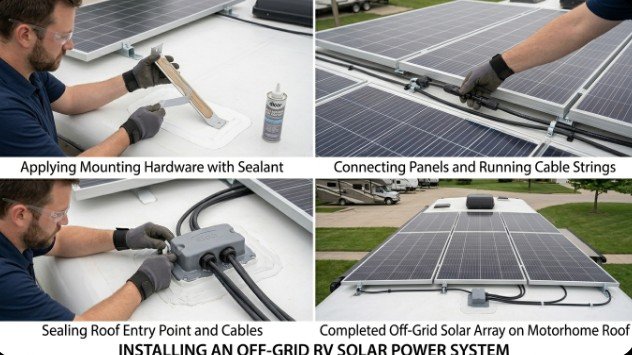
Step 3 — Install Mounting Brackets or Rails
- Use corrosion-resistant hardware
- Secure with screws or strong adhesive sealant
- Ensure wind resistance for highway travel
Step 4 — Position and Secure Solar Panels
- Align panels with brackets carefully
- Tighten bolts evenly
- Avoid over-tightening to prevent panel damage
Step 5 — Seal All Mounting Points Properly
- Apply RV-grade waterproof sealant
- Prevent leaks and roof damage
- Double-check every drilled hole
Step 6 — Wire Panels to Charge Controller
- Connect positive and negative cables correctly
- Route wiring through roof entry gland
- Ensure all wiring is insulated and protected
Step 7 — Connect to RV Battery System
- Install charge controller near batteries
- Connect terminals securely
- Test system output for proper voltage
Tools and Materials Needed for Installation
Essential Installation Tools
- Drill and screwdriver set
- Sealant gun
- Measuring tape
- Voltage meter
H3: Required Solar Equipment
- Solar panels (100W–400W typical)
- Mounting brackets or Z-brackets
- MPPT or PWM charge controller
- Solar cables and connectors
- Roof entry gland
Safety Guide for RV Solar Installation
Step 1 — Disconnect RV Power System
Always disconnect batteries before starting work.
Step 2 — Avoid Roof Structural Weak Points
Do not drill near vents or thin roof sections.
Step 3 — Use UV and Waterproof Sealants
Protect against sun damage and water intrusion.
Step 4 — Secure Wiring Against Wind Vibration
Use clips and conduit for long-term durability.
Step 5 — Follow Electrical Polarity Correctly
Incorrect wiring can damage the entire system.
RV Solar Mounting Options
| Mount Type | Cost | Installation Difficulty | Efficiency | Best For |
|---|---|---|---|---|
| Fixed Mount | Medium | Moderate | High | Full-time RV use |
| Tilt Mount | Higher | Advanced | Very High | Maximum solar output |
| Portable System | Low–Medium | Easy | Variable | Flexible camping setups |
Common Mistakes When Mounting Solar Panels on RV Roof
Poor Roof Sealing After Drilling
Leads to leaks and long-term damage.
Incorrect Panel Placement Blocking Sunlight
Reduces solar efficiency significantly.
Using Weak or Rust-Prone Mounts
Causes instability during travel.
Improper Wiring Connections
Can damage batteries or controllers.
Ignoring RV Roof Weight Limits
May compromise roof structure integrity.
Sub-Questions People Also Ask About RV Solar Installation
Can I install solar panels on my RV roof myself?
Yes, but basic electrical knowledge is required.
How many solar panels do I need for an RV?
Depends on energy usage and battery size.
Do RV solar panels work on cloudy days?
Yes, but at reduced efficiency.
What direction should RV solar panels face?
Toward the sun’s path south in most U.S. regions.
How long do RV solar panels last?
Typically 20–25 years.
Do I need a charge controller for RV solar panels?
Yes, it regulates battery charging safely.
Can RV solar panels charge batteries directly?
Not safely always use a controller.
Are flexible solar panels better for RV roofs?
They are lighter but less durable than rigid panels.
FAQs About How to Mount Solar Panels on RV Roof?
What is the safest way how to mount solar panels on RV roof?
Follow proper wiring, sealing, and use certified mounting hardware.
Can solar panels damage my RV roof?
Only if installed incorrectly or sealed poorly.
How long does RV solar panel installation take?
Typically 4–8 hours depending on system size.
What is the cost of mounting solar panels on RV roof?
Ranges from $500 to $3,000+ depending on setup.
Do RV solar panels need maintenance?
Yes, mainly cleaning and periodic inspection.
Can I add more solar panels later?
Yes, if your controller supports expansion.
Do solar panels increase RV value?
Yes, especially for off-grid or full-time RV buyers.
What size solar system is best for RV living?
Most full-time RVers use 400W–1200W systems.
Conclusion — Safe and Effective Way to Mount Solar Panels on RV Roof
Key Takeaways
- Proper planning prevents roof damage and inefficiency
- Secure mounting and sealing ensure long-term durability
- Correct wiring guarantees safe energy production
Final Thoughts
Learning how to mount solar panels on RV roof correctly gives you true energy independence, especially for travelers exploring remote areas or coastal regions like Steinhatchee, Florida. With the right setup, your RV becomes a fully self-powered mobile home, reducing reliance on generators and enhancing your travel freedom for years to come.